The structure
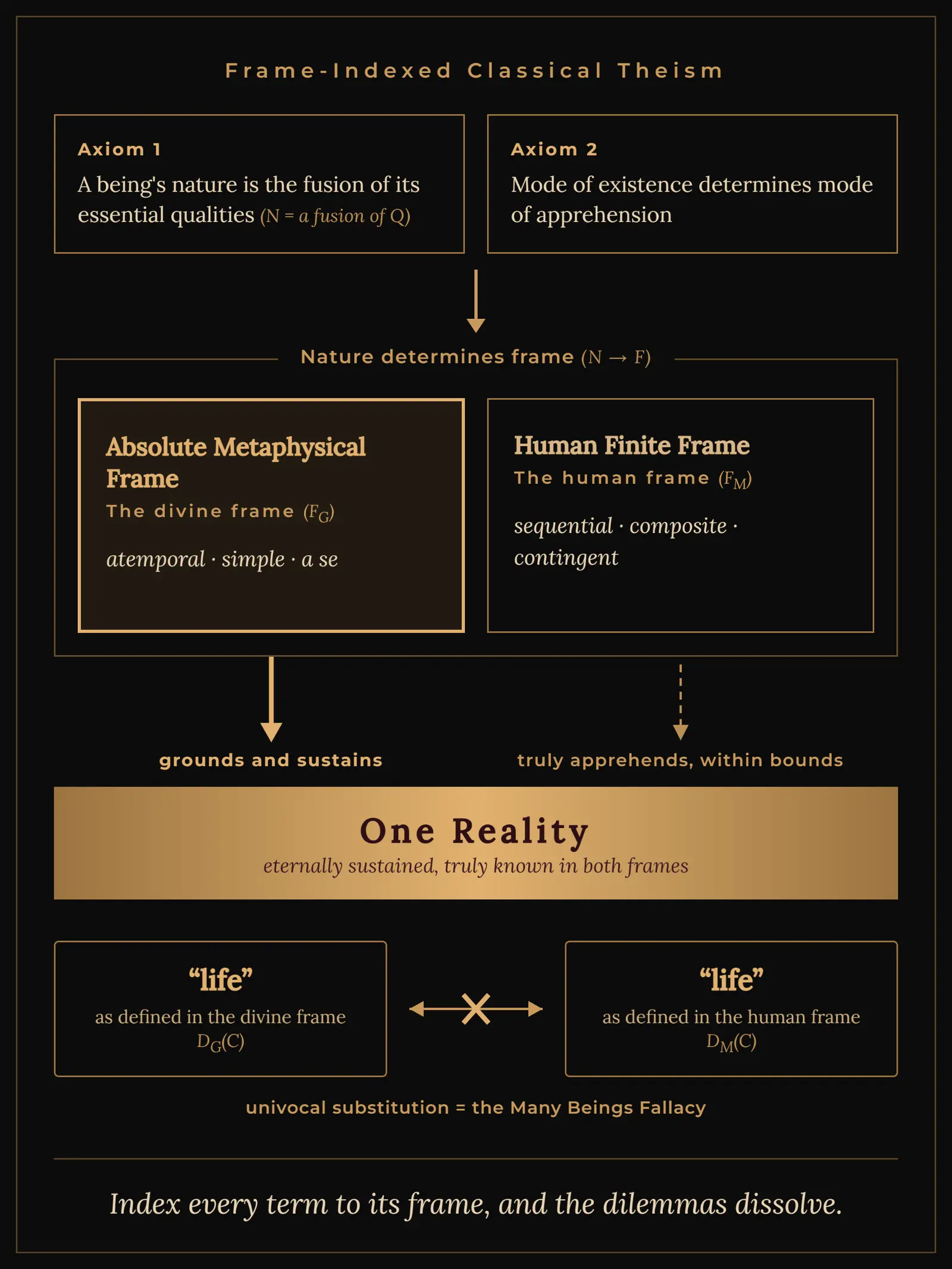
Two frames, one reality, and the substitution that breaks it.
The framework
A position in classical theism and philosophical theology holding that the classical dilemmas (sovereignty and free will, the problem of evil, time and eternity, immutability, infinity, relativity, quantum indeterminacy) are not mysteries to be endured. They are the same formal error, repeated. Classical theism has always held that terms do not transfer univocally to God; philosophical theology has rarely stated the rule that follows.
Frame-Indexed Classical Theism (FICT)
The position that classical theological dilemmas arise from predicating terms univocally across the divine and human frames, when a being’s nature fixes its frame of apprehension. Index each term to its frame and the contradiction dissolves. The underlying error is the Many Beings Fallacy.
The argument
Not a list of properties a thing happens to carry, but the single fused character from which everything else about it follows. Change an essential quality and you have not modified the being. You have named a different kind of being.
How a thing exists fixes how it can know. A being that exists sequentially apprehends sequentially. That is not a limitation bolted onto knowing; it is what knowing is for that kind of being.
It follows that
God’s frame of apprehension (atemporal, simple, self-existent) and man’s frame (sequential, composite, contingent) are incommensurable. One reality is truly known in both frames. But a term whose meaning is fixed inside one frame cannot be carried into the other without equivocating.
The Many Beings Fallacy
Taking a term defined inside the human frame and applying it univocally across the divine frame. Compatibilism and libertarianism argue about freedom; the free-will defence and soul-making theodicies argue about goodness; A-theory and B-theory argue about now. Each argument is downstream of the same unindexed term.
Isn’t this apophaticism in new clothes, saying we cannot really know anything about God?
The opposite. Apophaticism denies the content; frame-indexing preserves it and specifies its domain. The human frame gives real knowledge of the same reality: bounded, but not false. What the framework forbids is not speaking about God, but silently swapping a term between frames mid-argument. That is a rule you can check, which is why the framework can be shown wrong.
The structure
The framework in full
The short version is above. This is the argument at length: how the error is generated, why it survived scrutiny for so long, what indexing actually does to it, and what the framework would have to get wrong to be false.
Every classical dilemma has the same structure. A term is defined inside human experience, where it has a clear and well-behaved meaning. That term is then predicated of God. The predication feels legitimate because the word did not change, and because Scripture itself uses the word of God. But the conditions that gave the term its meaning did change, silently, in the move.
Take freedom. In the human frame it means something like: a choice is free when it issues from the agent and could have been otherwise. That definition presupposes sequence: a before in which the choice was open, and an after in which it is settled. It presupposes a knower who does not yet know the outcome. Both presuppositions belong to a being whose mode of existence is temporal and whose knowledge is acquired.
Now predicate that term across a frame in which neither presupposition holds. Nothing announces the failure. The sentence remains grammatical, the word remains familiar, and the argument proceeds, on a term that no longer means what it meant when it was defined.
The equivocation is invisible precisely because the word survives the move intact. Only its conditions are lost.
It is fair to ask how an error this basic went unnamed for so long, in a tradition that produced Augustine, Aquinas, Scotus, Owen and Edwards. Classical theism is not a careless tradition, and philosophical theology has never lacked rigour. Three reasons, and none of them is negligence.
First, the tradition repeatedly noticed the symptom without isolating the cause. Aquinas built the doctrine of analogy precisely because he saw that terms do not transfer univocally to God. Boethius distinguished divine eternity from everlasting duration for the same reason. Reformed theology drew the archetypal and ectypal distinction, marking off God’s self-knowledge from the derived knowledge available to creatures. Each is frame-indexing in a particular case. What none supplies is a general rule with a detection procedure.
Second, the error is productive. An unindexed term generates real arguments that behave like real arguments. They have premises, they support inferences, they can be defended and attacked. Compatibilism is a serious position. So is libertarianism. A dispute that generates good philosophy on both sides does not look like a dispute resting on a malformed term; it looks like a hard problem.
Third, the frames are asymmetric, so the error is one-directional and easy to miss. Moving a divine-frame term into human usage produces obvious nonsense and gets corrected immediately. Moving a human-frame term into divine usage produces something that sounds pious. It is the direction that flatters the speaker that goes uncorrected.
Classical theism has never claimed that terms mean the same thing of God and of creatures. Indexing a term does not weaken it, qualify it, or retreat into mystery. It specifies the conditions under which the term carries its meaning, and then holds the argument to those conditions on both sides.
Applied to sovereignty and free will: the Reformed claim is a claim in the divine frame, about what grounds and sustains an act. The Arminian claim is a claim in the human frame, about what the agent originates and is answerable for. Once indexed, these are not two answers competing for one slot. They are one act, truly described from two incommensurable frames, and the contradiction that seemed to require choosing a side turns out to have been generated by the assumption that only one description could be true.
What indexing does not do is make both sides right about everything. Calvinism is wrong when it denies that human liberty is genuine in the human frame. Arminianism is wrong when it treats divine determination as a competing cause at the same level. Molinism is not refuted so much as made unnecessary: middle knowledge is machinery built to solve a problem that indexing dissolves upstream of it. Each tradition loses something. What none loses is the claim it actually cared about.
Indexing is not a truce between positions. It is a claim that the disagreement was generated by a term neither side had pinned down.
The objection that arrives first is always the same: if terms mean different things in different frames, has the content not simply been relativised? It is the right objection, and the framework stands or falls on the answer.
Relativism holds that there is no privileged frame: that each perspective is as ultimate as any other, with no fact of the matter beyond them. Classical theism asserts the opposite, and this framework asserts it as a load-bearing premise rather than a caveat. The divine frame is the ground. It does not sit alongside the human frame as an alternative; it is what the human frame derives from and depends on. The human frame is a real but bounded mode of access to the same reality, not a separate reality of its own.
That asymmetry is doing all the work, and it is what keeps this inside classical theism rather than outside it. It is why the framework can say that human knowledge of God’s goodness is genuine rather than merely useful. It is why one description can be prior to another without making the second false. And it is what separates frame-indexing from the relativisms it superficially resembles, because a relativism with a privileged frame is not relativism at all.
A framework that cannot fail is not a framework. Three things would sink this one.
A dilemma that survives correct indexing. Index the disputed term to its frame on both sides, apply the rule honestly, and if the contradiction remains, the framework has failed for that case. Fail across several and the general claim goes with them. This is why the volumes work through the dilemmas one at a time in public rather than asserting a principle and moving on.
A demonstration that the frames are not in fact incommensurable: that a human-frame term can be carried into the divine frame univocally without equivocating. That would collapse the whole structure to a single frame, and every conclusion drawn from indexing with it.
A showing that the rule is unfalsifiable in practice: that “index the term” can be applied after the fact to rescue any conclusion whatever. If the discipline has no teeth, it is not a method but a rhetorical move, and it should be discarded as one.
Little of this is new to classical theism as a tradition; what is new is the discipline. The books are written in formal notation for exactly this reason. Notation is not decoration and it is not gatekeeping; it is what makes a specific step available to be attacked. A framework that can only be disagreed with in general terms cannot be trusted in particular ones.
Free — the complete book
Free, and the whole book — frame-indexing applied to sovereignty and free will across 34 chapters, so you can check the inferences yourself.
No spam. Unsubscribe in one click.
Applied
Each row names the rival positions the debate actually contains. The framework does not claim they are wrong about their own frame. It claims the disagreement is generated by an unindexed term, and disappears when that term is indexed.
| The dilemma | Where the rivals land | What frame-indexing shows | Volume |
|---|---|---|---|
| Sovereignty vs. free will | Calvinism, Arminianism, Molinism, compatibilism, theological fatalism | Freedom is a frame-indexed term. Divine determination and human liberty are not competing causes at one level; they are one act described from two incommensurable frames. | I |
| Goodness vs. evil | The free will defence, soul-making theodicy, privation theory, sceptical theism | Good is frame-indexed. The evidential problem quietly requires that divine goodness be commensurable with the human moral frame, and the premise doing the work is the one never stated. | II |
| Eternity vs. time | Eternalism, presentism, the growing block, divine timelessness, sempiternity | Now is frame-indexed. The A-theory and B-theory dispute assumes one privileged sense of the present that both frames must share. | III |
| Changelessness vs. interaction | Process theology, open theism, impassibility, theistic personalism | Change is frame-indexed. Divine repentance passages describe a real relation in the human frame without requiring alteration in the divine one. | IV |
| Infinity vs. beginning | The kalam argument, infinite regress, Cantor’s transfinites, creation ex nihilo | Infinite is frame-indexed. Potential and actual infinity are not two sizes of the same quantity; they belong to different frames of apprehension. | V |
| Absoluteness vs. relativity | Special and general relativity, neo-Lorentzian theories, the block universe, absolute rest | Simultaneity is frame-indexed: a claim physics already makes, extended to the divine frame rather than abandoned there. | VI |
| Indeterminacy vs. providence | The Copenhagen interpretation, many-worlds, hidden-variable theories, meticulous providence | Chance is frame-indexed. An event genuinely indeterminate in the human frame is not thereby ungoverned in the divine one; the two descriptions are not competing for the same slot. | VII |
Pressure-testing
These are the four raised most often. If one of them lands, the framework fails, which is the point of stating them here.
No, because the frames are not symmetrical. God’s frame is the asymmetric ground; the human frame is a real but bounded mode of access to the same reality. The human sense of good is not a different subject matter. It is genuine knowledge of the same thing under the conditions a finite knower has.
This is the distinction Aquinas drew as analogy, and the one the Reformed tradition drew as archetypal and ectypal knowledge. Classical theism has always held something like it. The framework’s contribution is not the distinction; it is a stated rule for detecting when it has been violated.
A dilemma that survives correct indexing. If a term is indexed to its frame on both sides and the contradiction remains, the framework has failed for that case, and if it fails across several, the general claim goes with it. That is a higher bar than most philosophical theology sets for itself, and it is set deliberately.
That is why the volumes are written in formal notation with the inferences shown. A framework that cannot be attacked precisely cannot be trusted precisely.
Relativism denies a privileged frame. Classical theism asserts one, and so does this framework: the divine frame is the ground, and the human frame derives from it. Two frames, one reality, one of them prior. That asymmetry is doing the load-bearing work, and it is what separates frame-indexing from every relativist position it superficially resembles.
Because the arguments people actually leave the faith over are mostly this error wearing different clothes. “How could a good God permit this?” is not a hard question with a sad answer. It is a malformed question, and seeing why changes what the honest response is.
You do not need the notation, or any background in philosophical theology, to get that. Volume One works the dilemma through in full, and it is free.
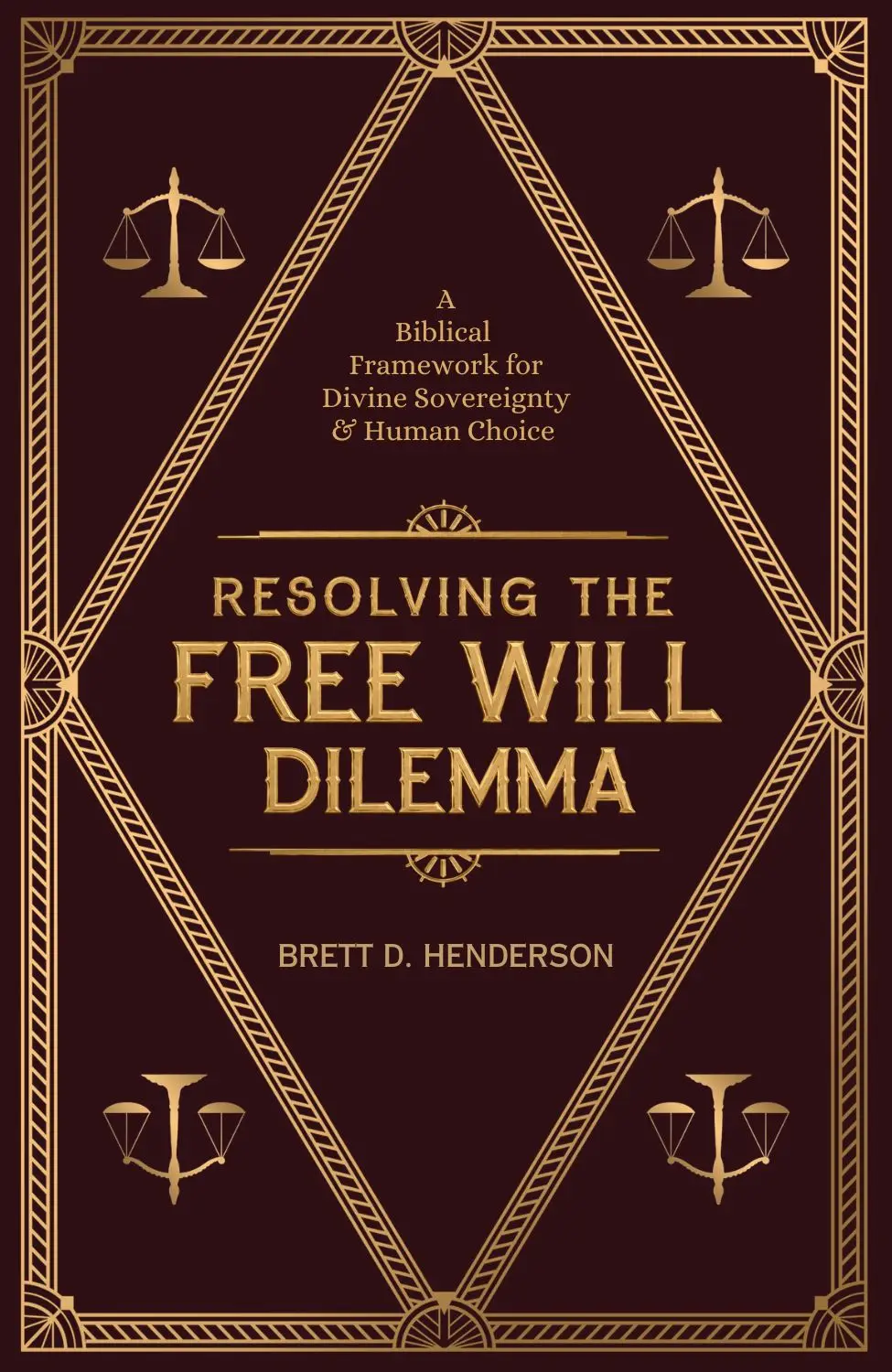
Free — the complete book
The complete book, not a sample chapter. Resolving the Free Will Dilemma applies frame-indexing to sovereignty and free will across 34 chapters — the fastest way to judge whether the method holds.
No spam. Unsubscribe in one click.
The complete framework
Seven dilemmas, one framework. Every published volume in one place, in reading order — Amazon takes the whole set in a single step.
Amazon’s own series page. Four of seven volumes are published.
Resolving the Free Will Dilemma — the complete book, not a sample. Calvinism, Arminianism and Molinism reconciled at the foundational level.
No spam. Unsubscribe in one click.