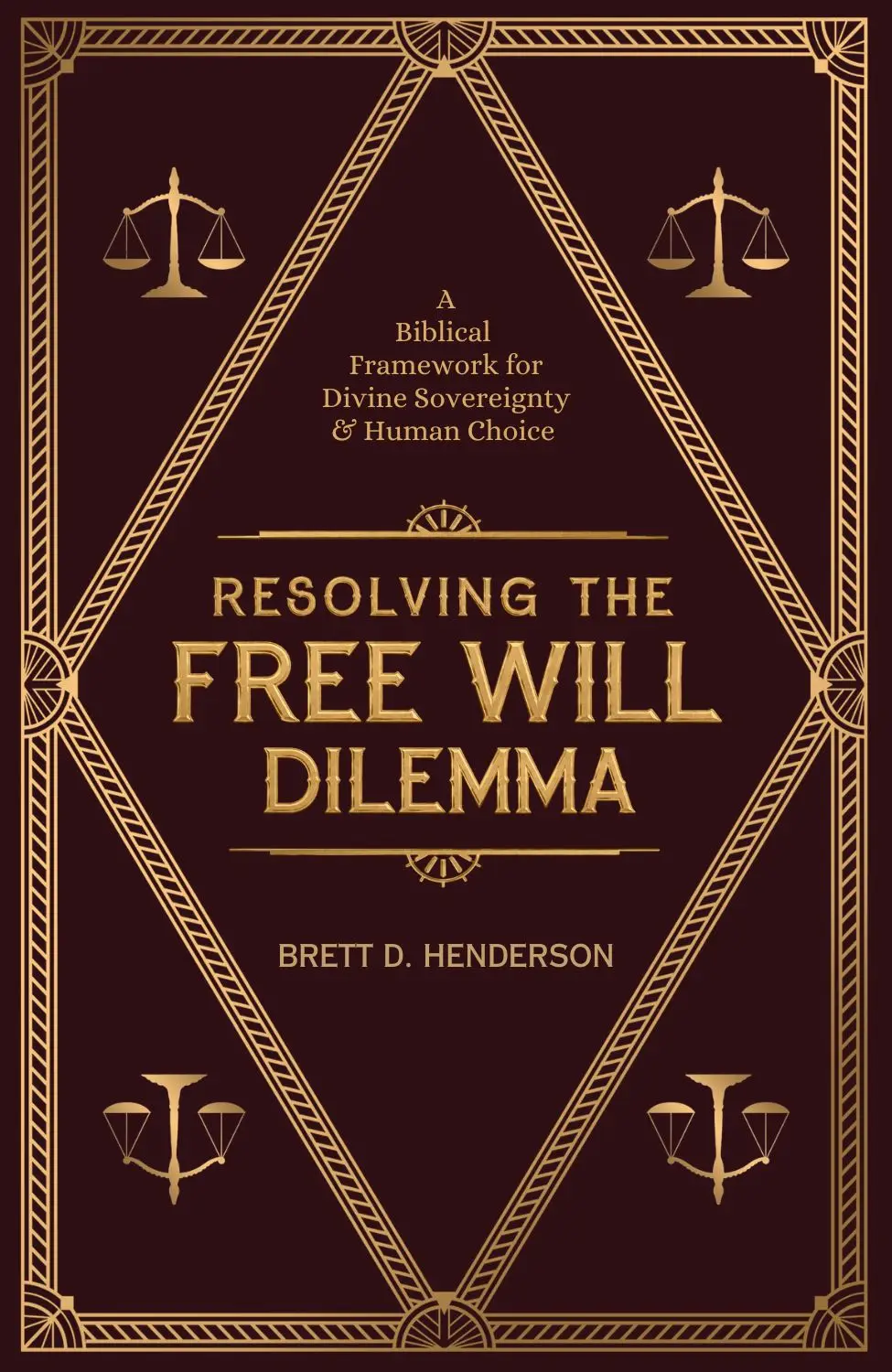
Free — the complete book
Start where the argument starts.
Resolving the Free Will Dilemma builds the framework from its two axioms and applies it in full. The complete book, free.
No spam. Unsubscribe in one click.
About
Brett D. Henderson is a Christian author writing analytic philosophical theology. His main work is The Many Beings Framework, a seven-volume research programme arguing that the Church’s oldest dilemmas (sovereignty and free will, the problem of evil, time and eternity, immutability, infinity, relativity, and quantum indeterminacy) are not mysteries to be endured but instances of a single formal error committed so consistently it went unnamed.
That error has a name now: the Many Beings Fallacy. It is what happens when a term defined inside human experience (free, good, now) is predicated of a Being whose mode of existence differs in kind. The position built on identifying it is Frame-Indexed Classical Theism.
The work formalises what the tradition already half-knew. Aquinas built the doctrine of analogy because he saw terms do not transfer univocally to God. Boethius distinguished eternity from everlasting duration. Reformed theology drew the archetypal and ectypal distinction. Each is frame-indexing in a particular case; none supplies a general rule. The framework supplies the rule, states it, and applies it uniformly, which is what makes it possible to show it is wrong.
Every volume is written in formal notation and published for peer scrutiny. That is a deliberate cost. Notation narrows the audience and it makes specific steps available to attack, which is the trade the work exists to make. A framework that can only be disagreed with in general terms cannot be trusted in particular ones.
As a Christian author he works in two registers rather than one. The Shepherd’s Path is a seven-book series for pastors, built on one idea: Jesus is the Logos, the reason and wisdom the Greeks were looking for, so using your mind to steward a ministry is not a failure of faith. Pray for the miraculous and steward the natural gifts. Neither series is a simplified version of the other; they are written for different readers and say so.
Free — the complete book
The fastest way to judge whether any of this holds is to read Volume One: the complete book, free.
No spam. Unsubscribe in one click.
The work
Two series, two readers, one framework underneath. Most work by a Christian author aims at a single audience; this deliberately does not, and neither series is a watered-down version of the other.
The main body of work by this Christian author. Seven volumes, each taking one classical dilemma and resolving it by indexing the term that generates it. Volume One handles sovereignty and free will, and is permanently free on Kindle so the method can be tested before anything is bought.
Every volume reads standalone. Each opens by rebuilding the framework from its two axioms, so no book depends on another. The repetition is deliberate rather than lazy. Parts Two and Three of each are unique: the dilemma resolved, then the tradition engaged directly, at full strength rather than in summary.
The shelf this sits on sells multi-view comparison volumes: four views, five views, essays talking past one another between two covers. This series does the opposite. One position, argued straight through, with the inferences shown so a reader can attack a specific step rather than a general impression.
Seven books on the practical work of leading a church, written for a pastor with a growth problem rather than a philosopher with a puzzle. Vision, strategy, growth, discipleship, marketing, evangelism, decision-making.
The register is deliberately different: short sentences, concrete examples, one idea per section. The theology is carried underneath rather than displayed on top. What the two series share is the conviction that thinking carefully is an act of stewardship, not a substitute for faith.
Free — the complete book
Resolving the Free Will Dilemma builds the framework from its two axioms and applies it in full. The complete book, free.
No spam. Unsubscribe in one click.
Resolving the Free Will Dilemma — the complete book, not a sample. Calvinism, Arminianism and Molinism reconciled at the foundational level.
No spam. Unsubscribe in one click.